Ascanio
Alexandre Dumas
THE ROMANCES OF ALEXANDRE DUMAS
ASCANIO
PARTS I. AND II.
Volume XI.
THE ROMANCES OF
ALEXANDRE DUMAS
Volume XI.
ASCANIO
PART FIRST
INTRODUCTORY NOTE
"Never perhaps," says Miss Pardoe (in the Preface to the "Court and Reign of Francis I."), "did the reign of any European sovereign present so many and such varying phases. A contest for empire, a captive monarch, a female regency, and a religious war; the poisoned bowl and the burning pile alike doing their work of death amid scenes of uncalculating splendor and unbridled dissipation; the atrocities of bigotry and intolerance, blent with the most unblushing licentiousness and the most undisguised profligacy;—such are the materials offered to the student by the times of Francis I."
The period thus characterized is that in which the scene of the present romance is laid, and although the plot is mainly concerned with the fortunes of others than subjects of the Roi Chevalier, we are treated to a succession of vivid pictures of life and manners at the French court and in the French capital.
The author depicts the king rather as he appeared to the world before what has been called the "legend of the Roi Chevalier,"—that is to say, the long prevailing idea that François I. was the most chivalrous monarch who ever sat upon a European throne,—had been modified by the independent researches of those who have not feared to go behind the writings of the old and well tutored chroniclers whose works have formed the basis of most modern histories,—chroniclers who seem to have been guided by Cardinal Richelieu's famous remark to an aspiring historian, apropos of certain animadversions upon the character of Louis XI., that "it is treason to discuss the actions of a king who has been dead only two centuries."
The result of these researches is thus summed up by Miss Pardoe in the same Preface:—
"The glorious day of Marignano saw the rising, and that of Pavia the setting, of his fame as a soldier; so true it is that the prowess of the man was shamed by that of the boy. The early and unregretted death of one of his neglected queens, and the heart-broken endurance of the other, contrasted with the unbounded influence of his first favorite and the insolent arrogance of his second, will sufficiently demonstrate his character as a husband. His open and illegal oppression of an overtaxed and suffering people to satisfy the cravings of an extortionate and licentious court, will suffice to disclose his value as a monarch; while the reckless indifference with which he falsified his political pledges, abandoned his allies in their extremity in order to further his own interests, and sacrificed the welfare of his kingdom and the safety of his armies to his own puerile vanity, will complete a picture by no means calculated to elicit one regret that his reign was not prolonged."
Victor Hugo dared to puncture the "legend," when, in the play of "Le Roi s'Amuse," he represented the "knightly king" as being enticed to a low water-side hovel by the charms of a girl of the street; but even the government of the Citizen King, Louis-Philippe, could not brook such an attack upon the "divinity that doth hedge a king," and, after the first performance in 1832, the strong hand of the censorship was laid upon the play, and fifty years elapsed before it again saw the light upon the stage.
The first titular favorite of King François, the Comtesse de Châteaubriand, whose character was in every respect diametrically opposed to that of her successor, was an object of dislike and dread to Louise de Savoie, the king's mother, because of her unbounded influence over François. When he returned to France, after his captivity in Spain following upon his defeat at Pavia, his passion for Madame de Châteaubriand was found to have increased rather than diminished. In looking about for some means to kill this passion, and in that way put an end to the influence of the favorite, Louise de Savoie was not obliged to go beyond the lovely and licentious circle of her own maids of honor. She found in Anne de Pisseleu, Mademoiselle d'Heilly, that combination of loveliness, youth, frailty, and forwardness which she required for her purpose, and so arranged her first presentation to the king that the desired effect was produced almost immediately. It was not long before a suitably complaisant husband was found for the new divinity, in the person of the Duc d'Etampes, and she had soon entirely supplanted Madame de Châteaubriand, driven her from court, and entered upon a period of queenly power and magnificence, which was to endure with little change or diminution for full twenty years, and until the death of her royal lover and slave in 1547.
"His excessive passion for the artful favorite blinded him to her vices," says Miss Pardoe. "Already had she taught him that her love was to be retained only by an entire devotion; and even while he suffered her to become the arbiter of his own actions, she betrayed him with a recklessness as bold as it was degrading. Nothing, moreover, could satisfy her rapacity; and while distress, which amounted almost to famine, oppressed the lower classes of the citizens, she greedily seized upon every opportunity of enriching herself and aggrandizing her family."[1]
The following passage from the same interesting and painstaking work, if compared with the episode in "Ascanio" of Madame d'Etampes's designs upon Colombe, will serve to illustrate the extreme fidelity to historical truth, even in what may seem to be minor matters, which so amply justifies the title of "Historical Romances" as applied to this and many other of Dumas's works:—
"We pass over, for obvious reasons, the minor influences, each perhaps insignificant in itself, but in the aggregate fearfully mischievous, which were exercised by the fair and frail maids of honor, each, or nearly each, being in her turn the 'Cynthia of the minute,' and more than one of whom owed her temporary favor to the Duchesse d'Etampes herself, whose secret intrigues and undisguised ambition absorbed more of her time than could have been left at her disposal, had she not provided the inconstant but exacting monarch with some new object of interest; and the tact with which she selected these facile beauties was not one of the least of her talents. Never, upon any occasion, did she direct the attention of the king to a woman whose intellect might have secured, after the spell of her beauty had ceased to attract him. The young and the lovely were her victims only when their youth and their loveliness were their sole attractions. She was ever ready to supply her royal lover with a new mistress, but never with a friend, a companion, or a counsellor; and then, as she had rightly foreseen, the French Sardanapalus soon became sated by the mere prettiness of his female satellites, and returned to his allegiance to herself, weaned, and more her slave than ever."[2]
A curious parallel in this regard may be noted between the course of the Duchesse d'Etampes and the similar one pursued by Madame de Pompadour, two centuries later, to maintain her power over the prematurely aged Louis XV. The policy of this "minister in petticoats" was embodied in the institution of the famous, or infamous, Parc-aux-Cerfs.
The request of the Emperor Charles V. to be allowed to pass through France on his way to chastise the rebellious people of Ghent, and the conflicting emotions to which it gave rise at the French court, have been much discussed by historians. It seems to have been the case that the Connétable Anne de Montmorency—then in the prime of life, and whom readers of the "Two Dianas" will remember in his old age as the loser of the battle of Saint-Laurent, and the favored rival of King Henri II. in the affections of Diane de Poitiers—was the only one of the king's advisers who opposed requiring Charles to give sureties of his peaceable intentions, and to declare in writing that he traversed France only upon sufferance. The constable's advice was adopted, notwithstanding the opposition of Madame d'Etampes, who strongly urged the king to take revenge for his own imprisonment at Madrid by improving the opportunity to inflict the same treatment upon his life-long rival and adversary. The incident of Triboulet, the jester, and the tablets upon which he inscribed the names of the greatest fools in the world, is historical.
The anecdote of the presentation of the diamond ring by the Emperor to the favorite is told by Miss Pardoe substantially as by Dumas, but it is rejected by most historians of the time. There is no question, however, that the duchess was so alarmed by the condition of the king's health, which was prematurely impaired by his dissolute life, and so apprehensive of her own fate when he should be succeeded by the Dauphin Henri, then a willing slave to the charms of her bitter enemy, Diane de Poitiers, that she exerted herself to the utmost to win the affection of the young Duc d'Orléans, and to procure some sort of an independent government for him. All her plans in that direction were defeated by that prince's death of the plague in 1545.
The dazzling and voluptuous Diane de Poitiers, mistress of two kings of France, the beautiful and accomplished, but cruel and treacherous Catherine de Medicis, wife of one and mother of three, are familiar historical characters, with whom Dumas has dealt more fully in others of his works.
The learned and accomplished author of the "Heptameron," Marguerite de Valois, Queen of Navarre and sister of François I., of whom we obtain a fleeting glimpse or two, is in many respects the most attractive personality of the time. It is a cause for deep regret, however, that her great affection for her brother did not lead her to exert her undoubted influence over him to a better end.
As we pass from the king and his immediate circle, to glance for a moment at the other characters, with whom and with certain passages in their lives the romance before us is mainly concerned, we venture to quote once more the same author so copiously quoted heretofore:—
"One merit must, however, be conceded to Anne de Pisseleu; and as throughout her whole career we have been unable to trace any other good quality which she possessed, it cannot be passed over in silence. Educated highly for the period, she loved study for its own sake, and afforded protection to men of letters; although it must be admitted that, wherever her passions or vanity were brought into play, she abandoned them and their interests without hesitation or scruple. Nevertheless it is certain that she co-operated, not only willingly, but even zealously, with the king, in attracting to the court of France all the distinguished talent of Europe."[3]
The favorite's passions and vanity were brought into play in the ease of Benvenuto Cellini, and she certainly abandoned him and his interests without hesitation or scruple.
The principal source whence our knowledge of this extraordinary man is drawn, is his own Autobiography, which has been several times translated into English, most recently by that eminent author and critic, the late John Addington Symonds.
The following extracts from the translator's scholarly Introduction will serve a useful purpose in that they will show that the picture drawn of him by Dumas is in no sense exaggerated, and that he really possessed the extraordinary characteristics attributed to him in the following pages, and which would seem almost incredible without some confirmatory evidence:—
"A book which the great Goethe thought worthy of translating into German with the pen of 'Faust' and 'Wilhelm Meister,' a book which Auguste Comte placed upon his very limited list for the perusal of reformed humanity, is one with which we have the right to be occupied, not once or twice, but over and over again.
"No one was less introspective than this child of the Italian Renaissance. No one was less occupied with thoughts about thinking or with the presentation of psychological experience. Vain, ostentatious, self-laudatory, and self-engrossed as Cellini was, he never stopped to analyze himself. . . . The word 'confessions' could not have escaped his lips; a Journal Intime would have been incomprehensible to his fierce, virile spirit. His Autobiography is the record of action and passion. Suffering, enjoying, enduring, working with restless activity; hating, loving, hovering from place to place as impulse moves him; the man presents himself dramatically by his deeds and spoken words, never by his ponderings or meditative broodings.
"In addition to these solid merits, his life, as Horace Walpole put it, is 'more amusing than any novel.' We have a real man to deal with,—a man so realistically brought before us that we seem to hear him speak and see him move; a man, moreover, whose eminently characteristic works of art in a great measure still survive among us. Yet the adventures of this potent human actuality will bear comparison with those of Gil Bias, or the Comte de Monte Cristo, or Quentin Durward, or Les Trois Mousquetaires, for their variety and pungent interest.
"But what was the man himself? It is just this question which I have half promised to answer, implying that, as a translator, I have some special right to speak upon the subject.
"Well, then: I seem to know Cellini first of all as a man possessed by intense, absorbing egotism; violent, arrogant, self-assertive, passionate; conscious of great gifts for art, physical courage, and personal address. . . . To be self-reliant in all circumstances; to scheme and strike, if need be, in support of his opinion or his right; to take the law into his own hands for the redress of injury or insult;—this appeared to him the simple duty of an honorable man. . . . He possessed the temperament of a born artist, blent in almost equal proportions with that of a born bravo. Throughout the whole of his tumultuous career these two strains contended in his nature for mastery. Upon the verge of fifty-six, when a man's blood has generally cooled, we find that he was released from prison on bail, and bound over to keep the peace for a year with some enemy whose life was probably in danger; and when I come to speak about his homicides, it will be obvious that he enjoyed killing live men quite as much as casting bronze statues.
"He consistently poses as an injured man, whom malevolent scoundrels and malignant stars conspired to persecute. Nor does he do this with any bad faith. His belief in himself remained firm as adamant, and he candidly conceived that he was under the special providence of a merciful and loving God, who appreciated his high and virtuous qualities."
Bearing in mind that all the seemingly fabulous anecdotes related of Cellini, or put into his own mouth, by Dumas, are actually told by himself in his Autobiography, the conclusions of Mr. Symonds as to the artist's veracity cannot fail to be interesting:—
"Among Cellini's faults I do not reckon either baseness or lying. He was not a rogue, and he meant to be veracious. This contradicts the commonplace and superficial view of his character so flatly that I must support my opinion at some length. Of course I shall not deny that a fellow endowed with such overweening self-conceit, when he comes to write about himself, will set down much which cannot be taken entirely on trust. . . . Men of his stamp are certain to exaggerate their own merits, and to pass lightly over things not favorable to the ideal they present. But this is very different from lying; and of calculated mendacity Cellini stands almost universally accused. I believe that view to be mistaken."
Passing from general considerations to particular instances of Cellini's alleged falsehoods, the learned translator proceeds to discuss at some length many of the miraculous experiences and remarkable statements of Cellini, which are to be found in these volumes. For example, the founding of Florence by an imaginary ancestor of his own, named Fiorino da Cellino, a captain in the army of Julius Cæsar; and his claim that he shot the Constable of Bourbon from the ramparts of Rome in 1527, as to which Mr. Symonds says: "Bourbon had been shot dead in the assault of Rome upon that foggy morning, and Cellini had certainly discharged his arquebuse from the ramparts. . . . If it were possible to put his thoughts about this event into a syllogism, it would run as follows: 'Somebody shot Bourbon; I shot somebody; being what I am, I am inclined to think the somebody I shot was Bourbon."
It would be a much simpler task to make a list of the fictitious characters and incidents in "Ascanio," than to enumerate those whose existence or occurrence is well authenticated. Colombe and her governess are apparently creations of the novelist's brain, and the same is true of Hermann, little Jehan, Jacques Aubry and his light o' love. The Provost of Paris was Jean d'Estouteville, not Robert d'Estourville; but he was actually in possession of the Petit-Nesle, which was the abode granted to Benvenuto by a deed which is still extant, as are the letters of naturalization bestowed upon him. The trouble experienced by Cellini in obtaining possession of the Petit-Nesle is considerably overdrawn, and it does not appear that Ascanio was ever imprisoned. Ascanio's character throughout is represented in a different light from that in which it appears in the Autobiography, although he is there said to be "a lad of marvellous talents, and, moreover, so fair of person that every one who once set eyes on him seemed bound to love him beyond measure." Benvenuto had much trouble with him, and used continually to beat him; and he was very wroth when he found that his apprentice had been using the head of the mammoth statue of Mars as a trysting place, where he was accustomed to meet a frail damsel of his acquaintance. Benvenuto tells the story of the injury to the hand of Raffaello del Moro's daughter, and of his own share in her cure; but the element of romance is altogether wanting in his own narrative of the relations between himself and that "very beautiful" young woman.
Catherine and Scozzone (Scorzone) were two women, not one, both models and ephemeral mistresses of the artist. The episode of the amours of Pagolo and Catherine is a very much softened version of an almost unreadable passage in the memoirs. Of the episode itself, as told by Cellini, Mr. Symonds says that it is one over which his biographers would willingly draw the veil.
It is impossible to imagine a more natural consequence of Benvenuto's peculiar temperament than his absolute failure to make himself persona grata to the arrogant, self-seeking mistress of the King of France. François was oftentimes hard put to it to reconcile his admiration for the work of the artist with his desire to please the favorite; but in presence of one of his masterpieces the former sentiment generally carried the day,—notably on the occasion of the exhibition of the Jupiter at Fontainebleau, in competition with the antique statues brought from Rome by Primaticcio. After describing the scene in the gallery substantially as it is described in the novel, Cellini says: "The king departed sooner than he would otherwise have done," (on account of the rage of the duchess,) "calling aloud, however, to encourage me, 'I have brought from Italy the greatest man who ever lived, endowed with all the talents.'"
A passage in Mr. Symonds's Introduction to the Life, too long to be quoted here, shows that Benvenuto left France somewhat under a cloud, and followed by suspicions of dishonest dealing, which have never been quite satisfactorily cleared away.
Enough has been said to show that in this book, as always in his historical romances, Dumas has substantially rewritten a chapter of history,—for the visit of Benvenuto Cellini to Paris has been deemed worthy of notice at considerable length by more than one grave chronicler; and he has again demonstrated his very exceptional power of interweaving history and fiction in such a way as to make each embellish the other.
[1]The Court and Reign of Francis I., King of France, Vol. II. Chap. XI.
[2]Miss Pardoe, Vol. III. Chap. I.
[3]Miss Pardoe. Vol. II. Chap XI.
LIST OF CHARACTERS
Period, 1540.
| FRANÇOIS I., King of France. |
| ELEANORA, his queen, sister to Charles V. |
| THE DAUPHIN,, afterwards Henri II. |
| CHARLES D'ORLÉANS, the king's second son. |
| THE DAUPHINE, Catherine de Medicis. |
| THE EMPEROR CHARLES V. |
| THE KING OF NAVARRE. |
| MARGUERITE DE VALOIS, Queen of Navarre. |
| ANNE DE PISSELEU, Duchesse d'Etampes, favorite of François I. |
| DIANE DE POITIERS. |
| BENVENUTO CELLINI, a Florentine artist. |
| ASCANIO, his pupil. |
| MESSIRE ROBERT D'ESTOURVILLE, Provost of Paris. |
| COLOMBE, his daughter. |
| COMTE D'ORBEC, the king's treasurer. |
| VICOMTE DE MARMAGNE, a suitor for Colombe's hand. |
| THE DUKE OF MEDINA-SIDONIA, ambassador of Charles V. |
| MONSIEUR DE MONTBRION, governor of Charles d'Orléans. |
| CONSTABLE ANNE DE MONTMORENCY,} |
| CHANCELLOR POYET,} |
| CARDINAL DE TOURNON,} |
| MESSIRE ANTOINE LE MAÇON,} |
| of the French Court. |
| COMTE DE LA FAYE,} |
| MARQUIS DES PRÉS,} |
| MELIN DE SAINT-GELAIS,} |
| M. DE TERMES,} |
| HENRI D'ESTIENNE,} |
| PIETRO STROZZI, a Florentine refugee. |
| TRIBOULET, the king's jester. |
| FRANÇOIS RABELAIS. |
| CLEMENT MAROT. |
| PAGOLO,} |
| JEHAN,} |
| assistants of Cellini. |
| SIMON-LE-GAUCHER,} |
| HERMANN,} |
| SCOZZONE, Cellini's model. |
| RUPERTA, servant to Cellini. |
| DAME PERRINE, Colombo's governess. |
| PULCHERIA, her assistant. |
| MASTER JACQUES, Messire d'Estourville's gardener. |
| ISABEAU, attendant of Madame d'Etampes. |
| ANDRÉ, physician to Madame d'Etampes. |
| JACQUES AUBRY, a student, attaching himself to the service of |
| Cellini. |
| GERVAISE-PERRETTE POPINOT, a grisette. |
| FRANCESCO PRIMATICCIO, a painter, friend to Cellini. |
| GUIDO, a Florentine physician, |
| FERRANTE,} |
| FRACASSO,} |
| bravos employed by Vicomte de Marmagne. |
| PROCOPE,} |
| MALEDENT,} |
| THE LIEUTENANT CRIMINAL OF THE PALAIS DE JUSTICE. |
| MARC-BONIFACE GRIMOINEAU, his clerk. |
| ETIENNE RAYMOND, a prisoner at the Châtelet. |
| A PRIEST AT THE CHÂTELET. |
| POPE CLEMENT VII. |
| MASTER GEORGIO, governor of the Castle of San Angelo. |
| MONSEIGNEUR DE MONTLUC, French ambassador at Rome. |
| POMPEO, a goldsmith at Rome. |
| RAPHAEL DEL MORO, a Florentine goldsmith. |
| STEFANA, his daughter. |
| GISMONDO GADDI, a confrère of Del Moro. |
CONTENTS
Chapter
I. The Street and the Studio
II. A Goldsmith of the Sixteenth Century
III. Dædalus
IV. Scozzone
V. Genius and Royalty
VI. To What Use A Duenna May Be Put
VII. A Lover and a Friend
VIII. Preparations for Attack and Defence
IX. Thrust and Parry
X. Of the Advantage of Fortified Towns
XI. Owls, Magpies, and Nightingales
XII. The King's Queen
XIII. Souvent Femme Varie
XIV. Wherein it is proven that Sorrow is
the Groundwork of the Life of Man
XV. Wherein it appears that Joy is nothing
more than Sorrow in another Form
XVI. A Court
XVII. Love as Passion
XVIII. Love as a Dream
XIX. Love as an Idea
ILLUSTRATIONS
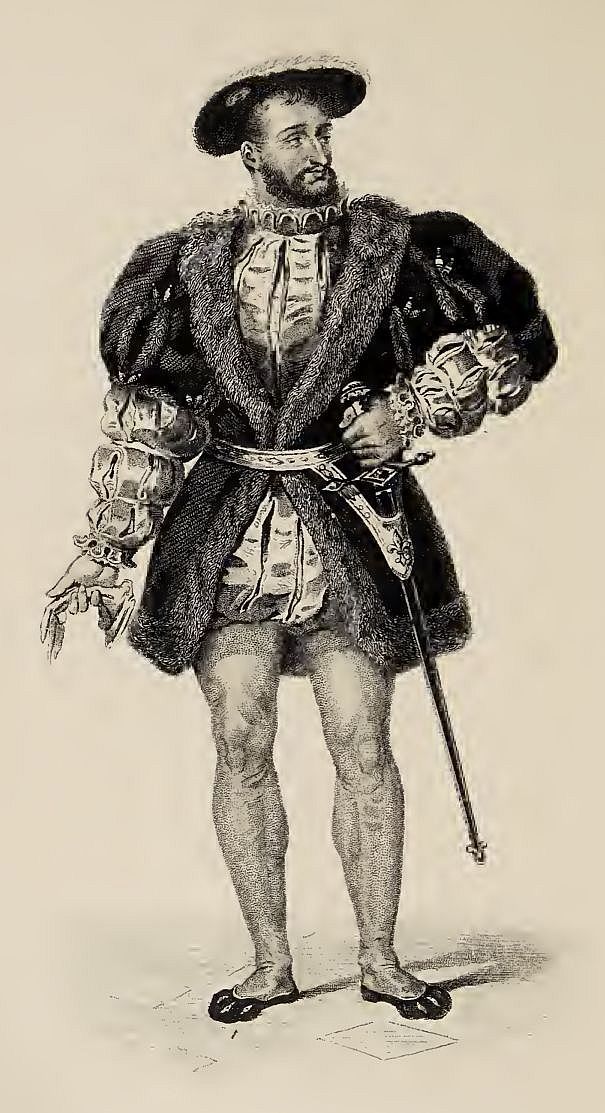
Francis I
Drawn by E. van Mughen.
Francis I. visits Benvenuto Cellini.
"Ascanio, beside himself with joy, fell on his
knees."
"'Your Majesty is losing your ring,' said
Anne."
"All the workmen joined in a cry of admiration."
ASCANIO
I
THE STREET AND THE STUDIO
Time, four o'clock in the afternoon of the tenth day of July in the year of grace 1540. Place, the entrance to the church Des Grands Augustins, within the precincts of the University, by the receptacle for holy water near the door.
A tall, handsome youth, olive-skinned, with long waving locks and great black eyes, simply but elegantly clad, his only weapon a little dagger with a hilt of marvellous workmanship, was standing there, and, doubtless from motives of pure piety and humility, had not stirred from the spot throughout the vespers service. With head bowed in an attitude of devout contemplation, he was murmuring beneath his breath I know not what words,—his prayers let us hope,—for he spoke so low that none but himself and God could hear what he might say. As the service drew near its close, however, he raised his voice slightly, and they who stood nearest him could hear these half-audible words:—
"How wretchedly these French monks drone out their psalms! Could they not sing more melodiously before her, whose ear should be accustomed to angels' voices? Ah! this is well; the vespers are at an end at last. Mon Dieu! mon Dieu! grant that I be more fortunate to-day than on last Sunday, and that she do at least raise her eyes to my face!"
This last prayer was most artful, in very truth; for if she to whom it was addressed should chance to raise her eyes to the suppliant's face, she would see the most adorable youthful head that she had ever seen in dreams, while reading the eleven mythological tales which were so fashionable at the time, by virtue of the charming couplets of Master Clement Marot, and which told of the loves of Psyche and the death of Narcissus. Indeed, beneath his simple sober-hued costume, the youth whom we have introduced to our readers was remarkably handsome, and wore an air of unmistakable refinement: moreover, his smile was infinitely sweet and attractive, and his glance, which dared not yet be bold, was as ardent and impassioned as ever flashed from the great speaking eyes of eighteen years.
Meanwhile, upon hearing the movement of many chairs announcing the end of the service, our lover,—for the reader will have discovered from the few words he has uttered that he is entitled to be so described,—our lover, I say, drew aside a little, and watched the congregation pass silently forth,—a congregation composed of staid church-wardens, respectable matrons past their giddy days, and prepossessing damsels. But for none of these had the youth come thither, for his glance did not brighten, nor did he step impulsively forward, until he saw approach a maiden dressed in white, and attended by a duenna,—a duenna of high station, be it understood,—who seemed accustomed to the ways of society, a duenna not unyouthful nor unattractive, and by no means savage in appearance. When the two ladies approached the basin of holy water, our youth took some of the liquid and gallantly offered it to them.
The duenna bestowed the most gracious of smiles and most grateful of courtesies upon him, and even touched his fingers as she took the cup, which, to his great chagrin, she herself handed to her companion; but the latter, notwithstanding the fervent prayer whereof she had been the object a few moments before, kept her eyes constantly upon the ground,—a sure proof that she knew the comely youth was there,—so that the comely youth, when she had passed, stamped upon the flags, muttering, "Alas! again she did not see me." An equally sure proof that the comely youth was, as we have said, no more than eighteen years old.
But after the first burst of vexation, our unknown hastened down the steps of the church, and, seeing that the absent-minded beauty, having lowered her veil and taken her attendant's arm, had turned to the right, hastened to take the same direction, observing that his own home chanced to lie that way. The maiden followed the quay as far as Pont Saint-Michel, and crossed Pont Saint-Michel; still it was our hero's road. She next passed through Rue de la Barillerie, and crossed Pont au Change; and as she was still pursuing our hero's road, our hero followed her like her shadow.
Every pretty girl's shadow is a lover.
But alas! when she reached the Grand Châtelet, the lovely star, whereof our unknown had made himself the satellite, was suddenly eclipsed: the wicket of the royal prison opened the instant that the duenna knocked, and closed again behind them.
The young man was taken aback for a moment; but as he was a very decided fellow when there was no pretty girl at hand to weaken his resolution, he very soon made up his mind what course to pursue.
A sergeant, pike on shoulder, was walking sedately back and forth before the door of the Châtelet. Our youthful unknown followed the example of the worthy sentinel, and, having walked on a short distance to avoid observation, but not so far as to lose sight of the door, he heroically began his amorous sentry-go.
If the reader has ever done sentry duty in the course of his life, he must have noticed that one of the surest means of making the time pass quickly is to commune with one's self. Our hero doubtless was accustomed to such duty, for he had hardly begun his promenade when he addressed the following monologue to himself:—
"Assuredly it cannot be that she lives in yonder prison. This morning after mass, and these last two Sundays when I dared not follow her save with my eyes,—dullard that I was!—she turned not to the right upon the quay, but to the left, toward the Porte de Nesle, and the Pré-aux-Cleres. What the devil brings her to the Châtelet? What can it be? To see a prisoner, perhaps, her brother 't is most like. Poor girl! she must suffer cruelly, for doubtless she is as sweet and kind as she is lovely. Pardieu! I'm sorely tempted to accost her, ask her frankly who it is, and offer my services. If it be her brother, I'll tell the patron the whole story, and ask his advice. When one has escaped from the Castle of San Angelo, as he has, one has a shrewd idea of the best way to get out of prison. There's no more to be said: I'll save her brother. After I have rendered him such a service, he'll be my friend for life and death. Of course he'll ask me then what he can do for me when I have done so much for him. Then I'll confess that I love his sister. He'll present me to her, and then we'll see if she won't raise her eyes."
Once launched upon such a course, we need not say how a lover's thoughts flow on unchecked. Thus it was that our youth was vastly amazed to hear the clock strike four, and see the sentinel relieved.
The new sergeant began his promenade, and the young man resumed his. His method of passing time had succeeded too well for him not to continue to make use of it; so he resumed his discourse upon a theme no less fruitful of ideas than the other:—
"How lovely she is! how graceful every movement! how modest her bearing! how classic the outline of her features! There is in the whole world no other than Leonardo da Vinci or the divine Raphael, worthy to reproduce the image of that chaste and spotless being; nor would they prove equal to the task, save at the very zenith of their talent. O mon Dieu! why am not I a painter, rather than a sculptor, worker in enamel, or goldsmith? First of all, were I a painter, there'd be no need that I should have her before my eyes to make her portrait. I should never cease to see her great blue eyes, her beautiful blonde tresses, her pearly skin and slender form. Were I a painter, I should paint her face in every picture, as Sanzio did with Fornarina, and Andrea del Sarto with Lucrezia. And what a contrast betwixt her and Fornarina! in sooth, neither the one nor the other is worthy to unloose her shoe laces. In the first place, Fornarina—"
The youth was not at the end of his comparisons, which were, as the reader will imagine, uniformly to the advantage of his inamorata, when the hour struck.
The second sentinel was relieved.
"Six o'clock! 'T is strange how the time flies!" muttered the youth, "and if it flies thus quickly while I wait for her, how should it be if I were by her side! Ah! by her side I should lose count of time; I should be in paradise. If I were by her side, I should but look at her, and so the hours and days and months would pass. What a blissful life that would be, mon Dieu!" and the young man lost himself in an ecstatic reverie; for his mistress, though absent, seemed to pass in person before his eyes,—the eyes of a true artist.
The third sentinel was relieved.
Eight o'clock struck on all the parish churches, and the shades of night began to fall, for all authorities are in accord that the twilight hour in July three hundred years ago was in the neighborhood of eight o'clock, as now; but what is perhaps more astonishing than that is the fabulous perseverance of a sixteenth century lover. All passions were ardent in those days, and vigorous young hearts no more stopped short in love than in art or war.
However, the patience of the young artist—for he has let us into the secret of his profession—was rewarded at last, when he saw the ponderous door of the Châtelet open for the twentieth time, but this time to give passage to her for whom he was waiting. The same chaperon was still at her side, and furthermore, two archers of the provost's guard followed ten paces behind her, as escort.
They retraced the steps they had taken four hours earlier, to wit the Pont au Change, Rue de la Barillerie, Pont Saint-Michel, and the quays; but they kept on by the Grands Augustins, and some three hundred yards beyond paused before a huge door in a recess in the wall, beside which was another smaller door for the servants' use. The duenna knocked at the great door, which was opened by the porter. The two archers, after saluting their charge with the utmost respect, returned to the Châtelet, and our artist found himself standing for the second time outside a closed door.
He would probably have remained there until morning, for he was fairly embarked on the fourth series of his dreams; but chance willed that a passer by, who had imbibed something too freely, collided violently with him.
"Hola there, friend!" said the new arrival, "by your leave, are you a man or a post? If so be you're a post, you're within your rights and I respect you; but if you be a man, stand back, and let me pass."
"Pray pardon me," rejoined the distraught youth, "but I am a stranger in this good city of Paris, and—"
"Oh! that's another matter; the Frenchman is always hospitable, and I ask your pardon; you're a stranger, good. As you have told me who you are, it's only fair that I should tell you who I am. I am a student, and my name is—"
"Excuse me," interposed the young artist, "but before I know who you are, I would be very glad to know where I am."
"Porte de Nesle, my dear friend; this is the Hôtel de Nesle," said the student, with a glance at the great door from which the stranger had not once removed his eyes.
"Very good; and to reach Rue Saint-Martin, where I live, which direction must I take?" said our lovelorn youth, for the sake of saying something, and hoping thus to be rid of his companion.
"Rue Saint-Martin, do you say? Come with me, I'm going that way, and at Pont Saint-Michel I'll show you how you must go. As I was saying, I am a student, I am returning from the Pré-aux-Clercs, and my name is—"
"Do you know to whom the Hôtel de Nesle belongs?" asked the young stranger.
"Marry! I rather think I know my University! The Hôtel de Nesle, young man, belongs to our lord, the king, and is at this moment in the hands of Robert d'Estourville, Provost of Paris."
"How say you! that the Provost of Paris lives there?"
"By no means did I tell you that the Provost of Paris lives there, my son: the Provost of Paris lives at the Grand Châtelet."
"Ah, yes! at the Grand Châtelet! Then that's the explanation. But how happens it that the provost lives at the Grand Châtelet, and yet the king leaves the Hôtel de Nesle in his possession?"
"'T is thus. The king, you see, had given the Hôtel de Nesle to our bailli, a most venerable man, who stood guard over the privileges of the University, and tried all suits against it in most paternal fashion: superb functions his! Unhappily our excellent bailli was so just—so just—to us, that his office was abolished two years since, upon the pretext that he used to sleep when hearing causes, as if bailli were not derived from bâiller (to yawn). His office being thus suppressed, the duty of protecting the interests of the University was intrusted to the Provost of Paris. A fine protector, on my word! as if we could not quite as well protect ourselves! How, our said provost—dost thou follow me, my child?—our said provost, who is most rapacious, opined that, since he succeeded to the bailli's office, he ought at the same time to inherit his possessions, and so he quietly laid hold of the Grand and Petit-Nesle, thanks to the patronage of Madame d'Etampes."
"And yet, you say, he does not occupy it."
"Not he, the villain. I think, however, that the old Cassandre lodges a daughter there, or niece, a lovely child called Colombe or Colombine, or some such name, and keeps her under lock and key in a corner of the Petit Nesle."
"Ah! is it so?" exclaimed the artist, hardly able to breathe, for it was the first time that he had heard his mistress's name; "this usurpation seems to me a shocking abuse. What! this vast hotel to shelter one young girl with her duenna!"
"Whence comest thou, O stranger, not to know that nothing comes to pass more naturally than this abuse,—that we poor clerks should live six together in a wretched garret, while a great nobleman casts this immense property with its gardens, lawns, and tennis-court to the dogs!"
"Ah! there is a tennis-court!"
"Magnificent, my son! magnificent!"
"But this Hôtel de Nesle, you say, is actually the property of King François I."
"To be sure: but what would you have King François I. do with this property of his?"
"Why, give it to others, as the provost doesn't occupy it."
"Very good: then go and ask it of him for yourself."
"Why not? Tell me, does the game of tennis please your fancy?"
"I fairly dote on it."
"In that case I invite you to a game with me next Sunday."
"Where, pray?"
"At the Hôtel de Nesle."
"Gramercy! my lord grand master of the royal châteaux! 'T is meet that you should know my name at least—"
But as the young stranger knew all that he cared to know, and as the rest probably interested him but little, he heard not a word of his new friend's story, as he proceeded to tell him in detail that his name was Jacques Aubry, that he was a scrivener at the University, and was now returning from the Pré-aux-Clercs, where he had had an assignation with his tailor's wife; that she, detained no doubt by her wrathful spouse, did not appear; that he had consoled himself for Simonne's absence by drinking good Suresne; and, lastly, that he proposed to withdraw his custom from the discourteous Master Snip, who compelled him to wear himself out with waiting, and to get tipsy which was altogether opposed to all his habits.
When the two young men reached Rue de la Harpe, Jacques Aubry pointed out to our unknown the road he was to follow, which he knew even better than his informant: they then made an appointment for the following Sunday at noon at the Porte de Nesle, and parted, one singing, the other dreaming.
He who dreamed had abundant food for dreaming, for he had learned more during that one evening than in the three weeks preceding.
He had learned that the maiden to whom he had given his heart, lived at the Petit-Nesle, that she was the daughter of Messire Robert d'Estourville, Provost of Paris, and that her name was Colombe. As will be seen, he had not wasted his day.
Still dreaming he turned into Rue Saint-Martin, and stopped before a handsome house, over the door of which were carved the arms of the Cardinal of Ferrara. He knocked three times.
"Who's there?" demanded a fresh, resonant young voice from within, after an interval of a few seconds.
"I, Dame Catherine," replied the unknown.
"Who are you?"
"Ascanio."
"Ah! at last!"
The door opened, and Ascanio entered.
A charming girl of some eighteen to twenty years, rather dark, rather small, very quick of movement, and admirably well shaped withal, welcomed him with transports of joy.
"Here's the deserter! here he is!" she cried, and ran, or rather bounded on before, to announce him, extinguishing the lamp she carried, and leaving open the street door, which Ascanio, less giddy-pated than she, was careful to secure.
The young man, although Dame Catherine's precipitation left him in darkness, walked with assured step across a courtyard of considerable size, in which every tile was surrounded by a border of rank weeds, the whole dominated by a sombre mass of tall buildings of somewhat severe aspect. It was the frowning and humid dwelling-place of a cardinal, although its master had not for a long time dwelt therein.
Ascanio sprang lightly up a flight of moss-grown steps, and entered a vast hall, the only room in the house that was lighted,—a sort of conventual refectory, ordinarily dark and gloomy and untenanted, but which for two months past had been filled with light and life and music.
For two months past, in truth, this cold colossal cell had been instinct with bustling, laughing, good-humored life; for two months past, ten work-benches, two anvils, and an improvised forge had seemed to lessen the size of the vast room; sketches, models, benches laden with pincers, hammers, and files, sheaves of swords with chased hilts of marvellous workmanship, and carved open-work blades, helmets, cuirasses, and bucklers, gold-embossed, whereon the loves of the gods and goddesses were portrayed in relief, as if to turn the mind away from the purpose for which they were destined to be used, had covered the grayish walls. The sun had freely found its way in through the wide open windows, and the air had been filled with the songs of joyous, active workers.
A cardinal's refectory had become a goldsmith's workshop.
However, during this evening of July 10, 1540, the sanctity of the Sabbath had temporarily restored to the newly enlivened apartment the tranquillity in which it had lain dormant for a century. But a table, upon which the remains of an excellent supper lay about in confusion, lighted by a lamp which one would take to have been stolen from the ruins of Pompeii, of so chaste and delicate a form was it, proved that, if the temporary occupants of the cardinal's mansion did sometimes enjoy repose, they were in no wise addicted to fasting.
When Ascanio entered there were four persons in the workshop.
These four persons were an old maid-servant, who was removing the dishes from the table, Catherine, who was relighting the lamp, a young man sketching in a corner, and waiting for the lamp which Catherine had taken from before him in order to continue his work, and the master, standing with folded arms, and leaning against the forge.
The last would inevitably have been the first to be observed by any one entering the workshop.
Indeed, there was an indescribable impression of life and power which emanated from this remarkable personage, and attracted the attention even of those who would have chosen to withhold it. He was a tall, spare, powerful man of some forty years; but it would have needed the chisel of Michel-Angelo or the pencil of Ribeira to trace the outline of that clear-cut profile, to reproduce that sparkling olive complexion, to depict that bold, almost kingly expression. His lofty forehead towered above eyebrows quick to frown; his straight-forward piercing glance flashed at times with a light that was almost sublime; his frank, good-humored smile, albeit somewhat satirical, fascinated and awed you at the same time; he was accustomed to stroke his black beard and moustache with his hand, which was not precisely small, but nervous, supple, with long fingers and great strength, but withal slender and aristocratic; lastly, in his way of looking at you, speaking, turning his head, in all his quick, expressive, but not intemperate gestures, even in the careless attitude in which he was standing when Ascanio entered, his strength made itself felt; the lion in repose was none the less the lion.
Catherine and the apprentice working in the corner formed a most striking contrast to each other. The latter, a sombre, taciturn fellow, with a narrow forehead already furrowed with wrinkles, half shut eyes, and compressed lips; she as blithe as a bird and blooming as a flower, with the most mischievous of eyes always to be seen beneath her restless eyelids, and the whitest of teeth within her mouth, constantly half opened with a smile. The apprentice, buried in his corner, was slow and languid in his movements, as if economizing his strength; Catherine was here and there, going and coming, never remaining one second in one spot, so did her youthful active organization overflow with life and spirits, and feel the need of constant movement in default of excitement.
Thus she was the fairy of the household, a very skylark by virtue of her vivacity, and her clear, piercing note, beginning life with such a joyous disregard of every thing beyond the moment as to fully justify the surname of Scozzone which the master had given her; an Italian word which signified then, and still signifies, something very like casse-cou (break-neck). And yet, with all her childish ways, Scozzone was so instinct with witchery and charm that she was the life and soul of the household; when she sang all the others were silent; when she laughed they laughed with her; when she ordered they obeyed without a word,—albeit she was not ordinarily exacting in her caprice; and then she was so frankly and innocently happy, that she diffused an atmosphere of good humor wherever she went, and it made others glad to see her gladness.
Her story was an old, old story, to which we may perhaps recur: an orphan, born of the people, she was abandoned in her infancy, but God protected her. Destined to afford pleasure to everybody, she met a man to whom she afforded pure happiness.
Having introduced these new characters, we now resume the thread of our narrative where we let it drop.
"Aha! whence comest thou, gadabout?" said the master to Ascanio.
"Whence do I come? I come from gadding about for you, master."
"Since morning?"
"Since morning."
"Say rather that thou hast been in quest of adventure?"
"What manner of adventure should I have been in quest of, master?" murmured Ascanio.
"How can I know, pray?"
"Well, well! and if it were so, where's the harm?" interposed Scozzone. "Indeed, he's a pretty boy enough to have adventures run after him, even though he run not after adventures."
"Scozzone!" said the master with a frown.
"Come, come! don't you be jealous of him, too, poor, dear boy!" And she raised Ascanio's chin with her hand. "Ah, well! it only needed that. But, Jesu! how pale you are! Does it happen that you haven't supped, monsieur vagabond?"
"Faith, no," cried Ascanio; "I forgot it."
"Oho! in that case I take sides with the master; he forgot that he had not supped, so he must be in love. Ruperta! Ruperta! bring supper for Messire Ascanio at once."
The servant produced several dishes of appetizing relics of the evening meal, which our hero pounced upon with an appetite by no means unnatural after his prolonged exercise in the open air.
Scozzone and the master watched him, smiling the while, one with sisterly affection, the other with a father's love. The young man at work in the corner had raised his head when Ascanio entered; but as soon as Scozzone replaced in front of him the lamp she had taken when she rail to open the door, he bent his head over his work once more.
"I was saying, master, that it was for you I have been running about all day," resumed Ascanio, noticing the mischievous expression of the master and Scozzone, and desiring to lead the conversation to some other subject than his love affairs.
"How hast thou run about all day for me? Let us hear."
"Did you not say yesterday that the light was very bad here, and that you must have another studio?"
"Even so."
"Well, I have found one for you."
"Dost thou hear, Pagolo?" said the master, turning to the young man in the corner.
"What did you say, master?" he asked, raising his head a second time.
"Come, lay aside thy work a moment, and listen to this. He has found a workshop: dost thou hear?"
"Pardon, master, but I can hear very well from here what my friend Ascanio may say. I would like to complete this study; it seems to me that it is well, when one has piously fulfilled the duties of a Christian on the Sabbath day, to employ one's leisure in some profitable exercise: to work is to pray."
"Pagolo, my friend," said the master, shaking his head more in sadness than in anger, "you would do better, believe me, to work more assiduously and heartily through the week, and enjoy yourself on Sunday like a good comrade, than to idle as you do on ordinary days, and hypocritically set yourself apart from the others by feigning so much ardor in your work on fete-days; but you are your own master, act as seems good to you. And thou sayest, Ascanio, my child?" he continued in a tone in which infinite gentleness and affection were mingled.
"I say that I have found a magnificent workshop for you."
"Where?"
"Do you know the Hôtel de Nesle?"
"Perfectly; that is, by having passed before it, for I have never been within the door."
"But is its exterior attractive in your eyes?"
"Pardieu! it is indeed. But—"
"But what?"
"But does no one occupy it, pray?"
"Marry, yes, Monsieur the Provost of Paris, Messire Robert d'Estourville, who has taken possession of it without right. Moreover, to satisfy your scruples on that head, we might with great propriety leave him the Petit-Nesle, where some one of his family now dwells, I think, and be content ourselves with the Grand-Nesle, and its courtyards, lawns, and bowling-greens and tennis-court."
"There is a tennis-court?"
"Finer than that of Santa-Croce at Florence."
"Per Bacco! and it is my favorite game; thou didst know that, Ascanio."
"Yes; and then, master, over and above all that, a superb location; air everywhere; and such air! perfect country air, and not such as we get here in this infernal corner, where we are moulding, forgotten by the sun. The Pré-aux-Clercs on one side, the Seine on the other, and the king, your great king, only two steps away, in his Louvre."
"But whose is this devil of a hotel?"
"Whose, say you? Pardieu! the king's."
"The king's! Say me that once more, my child,—the Hôtel de Nesle is the king's!"
"His own; now it remains to ascertain if he will give you so magnificent a dwelling-place."
"Who, the king? How do men call the king, Ascanio!
"Why, François I. if I am not mistaken."
"Which means that the Hôtel de Nesle will be my property within the week."
"But it may be that the Provost of Paris will take offence."
"What care I for that?"
"But suppose he will not let go what he has in his hand?"
"Suppose he will not!—What do men call me, Ascanio?"
"They call you Benvenuto Cellini, master."
"Which means that if the worthy provost will not do things with good grace, why, we will use force to compel him to do them. And now let us to bed. To-morrow we'll speak further on the matter, and then the sun will shine, and we shall see more clearly."
At the master's suggestion all retired except Pagolo, who remained for some time at work in his corner; but as soon as he believed that all were safely in bed, the apprentice rose, looked about, drew near the table, and poured for himself a large cup of wine, which he swallowed at a draught. Then he too went off to bed.
II
A GOLDSMITH OF THE SIXTEENTH CENTURY
Since we have drawn the portrait and mentioned the name of Benvenuto Cellini, we crave the reader's permission, that he may the more understandingly approach the artistic subject of which we propose to treat, to indulge in a short digression upon this extraordinary man, who at this time had been living in France for two months, and who is destined to become one of the principal characters of this history.
But first of all let us say a word as to the goldsmiths of the sixteenth century.
There is at Florence a bridge called the Ponte-Vecchio, which is covered with houses to this day; these houses were in the old days goldsmiths' shops.
But the word is not to be understood as we understand it to-day. The goldsmith of our day follows a trade; formerly, the goldsmith was an artist.
So it was that there was nothing in the world so wondrously beautiful as these shops, or rather as the articles with which they were stocked. There were round cups of onyx, around which dragons' tails were twined, while heads and bodies of those fabulous creatures confronted one another with gold-bespangled sky-blue wings outspread, and with jaws wide open like chimeras, shot threatening glances from their ruby eyes. There were ewers of agate, with a festoon of ivy clinging round the base, and climbing up in guise of handle well above the orifice, concealing amid its emerald foliage some marvellous bird from the tropics, in brilliant plumage of enamel, seemingly alive and ready to burst forth in song. There were urns of lapis-lazuli, over the edge of which leaned, as if to drink, lizards chiselled with such art that one could almost see the changing reflection of their golden cuirasses, and might have thought that they would fly at the least sound, and seek shelter in some crevice in the wall. Then there were chalices and monstrances, and bronze and gold and silver medallions, all studded with precious stones, as if in those days rubies, topazes, carbuncles, and diamonds could be found by searching in the sand on river banks, or in the dust of the highroad; and there were nymphs, naiads, gods, goddesses, a whole resplendent Olympus, mingled with crucifixes, crosses, and Calvarys; Mater Dolorosas, Venuses, Christs, Apollos, Jupiters launching thunderbolts, and Jehovahs creating the world; and all this not only cleverly executed, but poetically conceived; not only admirable, viewed as ornaments for a woman's boudoir, but magnificent masterpieces fit to immortalize the reign of a king or the genius of a nation.
To be sure, the goldsmiths of that epoch bore the names of Donatello, Ghiberti, Guirlandajo, and Benvenuto Cellini.
Now, Benvenuto Cellini has himself described in his memoirs, which are more interesting than the most interesting novel, the adventurous life of the artists of the fifteenth and sixteenth centuries, when Titian was painting in coat of mail, when Michel-Angelo was sculpturing with his sword at his side, when Masaccio and Domenichino died of poison, and Cosmo I. secluded himself in his laboratory to discover the mode of tempering steel so that it would cut porphyry.
To show the character of the man, we will take a single episode in his life,—that which was the occasion of his coming to France.
Benvenuto was at Rome, whither Pope Clement VII. had summoned him, and was at work with characteristic ardor upon the beautiful chalice which his Holiness had ordered; but as he desired to display his talent at its best upon the precious work, he made but slow progress. How, Benvenuto, as may well be imagined, had many rivals, who envied him the many valuable orders he received from the Pope, as well as the marvellous skill with which he executed them. The result was that one of his confrères, named Pompeo, who had nothing to do but slander his betters, took advantage of the delay to do him all possible injury in the Pope's sight, and kept at work persistently, day in and day out, without truce or relaxation, sometimes in undertones, sometimes aloud, assuring him that he would never finish it, and that he was so overwhelmed with orders that he executed those of other people to the neglect of his Holiness's.
He said and did so much, did good Pompeo, that when Benvenuto Cellini saw him enter his workshop one day with smiling faee, he divined at once that he was the bearer of bad news for him.
"Well, my dear confrère," Pompeo began, "I have come to relieve you from a heavy burden. His Holiness realizes that your neglect in completing his chalice is not due to lack of zeal, but to lack of time; he therefore considers it no more than just to relieve you from some one of your important duties, and of his own motion he dismisses you from the post of Engraver to the Mint. It will be nine paltry ducats a month less in your pocket, but an hour more each day at your disposal."
Benvenuto was conscious of an intense longing to throw the jeering varlet out of window, but he restrained his feelings, and Pompeo, seeing that not a muscle of his face moved, thought that he had missed his aim.
"Furthermore," he continued, "why, I know not, but in spite of all that I could say in your behalf, his Holiness demands his chalice at once, in whatever condition it may be. Verily, I am afraid, dear Benvenuto, I say it in all friendliness, that 't is his purpose to have some other finish it."
"Oh, no, not that!" cried the goldsmith, starting up like one bitten by a serpent. "My chalice is my own, even as the office at the Mint is the Pope's. His Holiness hath no right to do more than bid me return the five hundred crowns paid to me in advance, and I will dispose of my work as may seem good to me."
"Beware, my master," said Pompeo; "imprisonment may be the sequel of your refusal."
"Signore Pompeo, you're an ass!" retorted Benvenuto.
Pompeo left the shop in a rage.
On the following day two of the Holy Father's chamberlains called upon Benvenuto Cellini.
"The Pope has sent us," said one of them, "either to receive the chalice at your hands, or to take you to prison."
"Monsignori," rejoined Benvenuto, "an artist like myself deserved no less than to be given in charge to functionaries like yourselves. Here I am; take me to prison. But I give you fair warning that all this will not put the Pope's chalice forward one stroke of the graver."
Benvenuto went with them to the governor of the prison, who, having doubtless received his instructions in advance, invited him to dine with him. Throughout the repast the governor used every conceivable argument to induce Benvenuto to satisfy the Pope by carrying the chalice to him, assuring him that, if he would make that concession, Clement VII., violent and obstinate as he was, would forget his displeasure. But the artist replied that he had already shown the Holy Father his chalice six times since he began it, and that was all that could justly be required of him; moreover, he said he knew his Holiness, and that he was not to be trusted; that he might very well, when he had the chalice in his hands, take it from him altogether, and give it to some idiot to finish, who would spoil it. He reiterated his readiness to return the five hundred crowns paid in advance.
Having said so much, Benvenuto met all subsequent arguments of the governor by exalting his cook to the skies, and praising his wines.
After dinner, all his compatriots, all his dearest friends, all his apprentices, led by Ascanio, called upon him to implore him not to rush headlong to destruction by resisting the commands of Clement VII.; but Benvenuto told them that he had long desired to establish the great truth that a goldsmith can be more obstinate than a Pope; and as the most favorable opportunity he could ask for was now at hand, he certainly would not let it pass, for fear that it might not return.
His compatriots withdrew, shrugging their shoulders, his friends vowing that he was mad, and Ascanio weeping bitterly.
Fortunately Pompeo did not forget Cellini, and meanwhile he was saying slyly to the Pope,—
"Most Holy Father, give your servant a free hand; I will send word to this obstinate fellow that, since he is so determined, he may send me the five hundred crowns; as he is a notorious spendthrift he will not have that sum at his disposal, and will be compelled to give up the chalice to me."
Clement considered this an excellent device, and bade Pompeo do as he suggested. And so, that same evening, as Cellini was about to be taken to the cell assigned him, a chamberlain made his appearance, and informed the goldsmith that his Holiness accepted his ultimatum, and demanded the delivery of the chalice or the five hundred crowns without delay.
Benvenuto replied that they had but to take him to his workshop, and he would give them the five hundred crowns.
He was escorted thither by four Swiss, accompanied by the chamberlain. He entered his bedroom, drew a key from his pocket, opened a small iron closet built into the wall, plunged his hand into a large bag, took out five hundred crowns, and, having given them to the chamberlain, showed him and the four Swiss the door. It should be said, in justice to Benvenuto Cellini, that they received four crowns for their trouble, and in justice to the Swiss, that they kissed his hands as they took their leave.
The chamberlain returned forthwith to the Holy Father, and delivered the five hundred crowns, whereupon his Holiness, in his desperation, flew into a violent rage, and began to abuse Pompeo.
"Go thyself to my great engraver at his workshop, animal," he said, "employ all the soothing arguments of which thy ignorant folly is capable, and say to him that if he will consent to finish my chalice, I will give him whatever facilities he may require."
"But, your Holiness," said Pompeo, "will it not be time to-morrow morning?"
"I fear lest it be already too late this evening, imbecile, and I do not choose that Benvenuto shall sleep upon his wrath; therefore do my bidding on the instant, and let me not fail to have a favorable reply to-morrow morning at my levée."
Pompeo thereupon left the Vatican with drooping feathers, and repaired to Benvenuto's workshop; it was closed.
He peered through the key-hole and through the cracks in the door, and scrutinized all the windows, one after another, to see if there was not one which showed a light; but all were dark. He ventured to knock a second time somewhat louder than at first, and then a third time, still louder.
Thereupon a window on the first floor opened, and Benvenuto appeared in his shirt, arquebus in hand.
"Who's there?" he demanded.
"I," the messenger replied.
"Who art thou?" rejoined the goldsmith, although he recognized his man at once.
"Pompeo."
"Thou liest," said Benvenuto; "I know Pompeo well, and he is far too great a coward to venture out into the streets of Rome at this hour."
"But, my dear Cellini, I swear—"
"Hold thy peace! thou art a villain, and hast taken the poor devil's name to induce me to open my door, and then to rob me."
"Master Benvenuto, may I die—"
"Say but another word," cried Benvenuto, pointing the arquebus toward his interlocutor, "and that wish of thine will be gratified."
Pompeo fled at full speed, crying "Murder!" and disappeared around the corner of the nearest street.
Benvenuto thereupon closed his window, hung his arquebus on its nail, and went to bed once more, laughing in his beard at poor Pompeo's fright.
The next morning, as he went down to his shop, which had been opened an hour earlier by his apprentices, he spied Pompeo on the opposite side of the street, where he had been doing sentry duty since daybreak, waiting to see him descend.
As soon as he saw Cellini, Pompeo waved his hand to him in the most affectionately friendly way imaginable.
"Aha!" said Cellini, "is it you, my dear Pompeo? By my faith! I was within an ace last night of making a churl pay dearly for his insolence in assuming your name."
"Indeed!" said Pompeo, forcing himself to smile, and drawing gradually nearer to the shop; "how did it happen, pray?"
Benvenuto thereupon described the incident to his Holiness's messenger; but as his friend Benvenuto had described him in their nocturnal interview as a coward, Pompeo did not dare confess his identity with the visitor. When his tale was finished, Cellini asked Pompeo to what happy circumstance he was indebted for the honor of so early a visit from him.
Pompeo thereupon acquitted himself, but in somewhat different terms, be it understood, of the errand upon which Clement VII. had sent him to his goldsmith. Benvenuto's features expanded as he proceeded. Clement VII. yielded; ergo the goldsmith had been more obstinate than the Pope.
"Say to his Holiness," said Benvenuto, when the message was duly delivered, "that I shall be very happy to obey him, and to do anything in my power to regain his favor, which I have lost, not by any fault of my own, but through the evil machinations of envious rivals. As for yourself, Signore Pompeo, as the Pope does not lack retainers, I counsel you, in your own interest, to look to it that another than you is sent to me hereafter; for your health's sake, Signore Pompeo, interfere no more in my affairs; in pity for yourself, never happen in my path, and for the welfare of my soul, Pompeo, pray God that I be not your Cæsar."
Pompeo waited to hear no more, but returned to Clement VII. with Cellini's reply, of which, however, he suppressed the peroration.
Some time thereafter, in order to put the seal to his reconciliation with Benvenuto, Clement VII. ordered his medallion struck by him. Benvenuto struck it in bronze, in silver, and in gold, and then carried it to him. The Pope was so enraptured with it that he cried out in his admiration, that so beautiful a medallion had never been produced by the ancients.
"Ah, well, your Holiness," said Benvenuto, "had not I displayed some firmness, we should have been at enmity to-day; for I would never have forgiven you, and you would have lost a devoted servant. Look you, Holy Bather," he continued, by way of good counsel, "your Holiness would not do ill to remember now and then the opinion of many discreet folk, that one should bleed seven times before cutting once, and you would do well also to allow yourself to be something less easily made the dupe of lying tongues and envious detractors; so much for your guidance in future, and we will say no more about it, Most Holy Father."
Thus did Benvenuto pardon Clement VII., which he certainly would not have done had he loved him less; but, as his compatriot, he was deeply attached to him. Great, therefore, was his sorrow when the Pope suddenly died, a few months subsequent to the episode we have described. The man of iron burst into tears at the news, and for a week he wept like a child. The Pontiff's demise was doubly calamitous to poor Cellini. On the very day of his burial he met Pompeo, whom he had not seen since the day when he bade him spare him the too frequent infliction of his presence.
It should be said that since Cellini's dire threats, the unhappy Pompeo had not dared to go out unless accompanied by a dozen men well armed, to whom he gave the same pay that the Pope gave his Swiss Guards; so that every walk that he took in the city cost him two or three crowns. And even when surrounded by his twelve sbirri, he trembled at the thought of meeting Benvenuto Cellini, for he knew that if the meeting should result in an affray, and any mishap should befall the goldsmith, the Pope, who was really very fond of him, would make him, Pompeo, pay dearly for it. But, as we have said, Clement VII. was dead, and his death restored some little courage to Pompeo.
Benvenuto had been to St. Peter's to kiss the feet of the deceased Pontiff, and was returning through the street Dei Banchi, accompanied by Pagolo and Ascanio, when he found himself face to face with Pompeo and his twelve men. At the sight of his enemy, Pompeo became very pale; but as he looked around and saw how amply provided he was with defenders, while Benvenuto had only two boys with him, he took heart of grace, halted, and nodded his head mockingly, while he toyed with the hilt of his dagger with his right hand.
At sight of this group of men by whom his master was threatened, Ascanio put his hand to his sword, while Pagolo pretended to be looking in another direction; but Benvenuto did not choose to expose his beloved pupil to so unequal a conflict. He laid his hand upon Ascanio's, pushing the half-drawn blade back into the scabbard, and walked on as if he had seen nothing, or as if he had taken no offence at what he saw. Ascanio could hardly recognize his master in such guise, but as his master withdrew, he withdrew with him.
Pompeo triumphantly made a deep salutation to Benvenuto, and pursued his way, still surrounded by his sbirri, who imitated his bravado.
Benvenuto bit his lips till the blood came, while externally his features wore a smile. His behavior was inexplicable to any one who knew the irascible nature of the illustrious goldsmith.
But they had not proceeded a hundred yards when he stopped before the workshop of one of his confrères, and went in, alleging as a pretext his desire to see an antique vase which had recently been found in the Etruscan tombs of Corneto. He bade his pupils go on to the shop, and promised to join them there in a few moments.
As the reader will understand, this was only a pretext to get Ascanio out of the way, for as soon as he thought that the young man and his companion, concerning whom he was less anxious because he was sure that such courage as he possessed would not carry him too far, had turned the corner of the street, he replaced the vase upon the shelf from which he took it, and darted out of the shop.
With three strides Benvenuto was in the street where he had met Pompeo; but Pompeo was no longer there. Luckily, or rather unluckily, this man, encompassed by his twelve sbirri, was a noticeable object, and so when Benvenuto inquired as to the direction he had taken, the first person to whom he applied was able to give him the information, and like a bloodhound that has recovered a lost scent Benvenuto started in pursuit.
Pompeo had stopped at a druggist's door, at the corner of the Chiavica, and was vaunting to the worthy compounder of drugs the prowess he had shown in his meeting with Benvenuto Cellini, when his eye suddenly fell upon the latter turning the corner of the street, with fire in his eye, and the perspiration streaming down his forehead.
Benvenuto shouted exultantly as he caught sight of him, and Pompeo stopped short in the middle of his sentence. It was evident that something terrible was about to happen. The bravos formed a group around Pompeo and drew their swords.
It was an insane performance for one man to attack thirteen, but Benvenuto was, as we have said, one of those leonine creatures who do not count their enemies. Against the thirteen swords which threatened him, he drew a small keen-edged dagger which he always wore in his girdle, and rushed into the centre of the group, sweeping aside two or three swords with one arm, overturning two or three men with the other, until he made his way to where Pompeo stood, and seized him by the collar. But the group at once closed upon him.
Thereupon naught could be seen save a confused struggling mass, whence issued loud shouts, and above which swords were waving. For a moment the living mass rolled on the ground, in shapeless, inextricable confusion, then a man sprang to his feet with a shout of triumph, and with a mighty effort, forced his way out of the group as he made his way in, bleeding himself, but triumphantly waving his blood-stained dagger. It was Benvenuto Cellini.
Another man remained upon the pavement, writhing in the agony of death. He had received two blows from the dagger, one below the ear, the other at the base of the neck behind the collar bone. In a few seconds he breathed his last,—it was Pompeo.
Any other than Benvenuto, after such a deed, would have taken himself off at full speed, but he passed his dagger to his left hand, drew his sword, and resolutely awaited the sbirri.
But the sbirri had no further business with Benvenuto; he who paid them was dead, and consequently could pay them no more. They ran off like a flock of frightened rabbits, leaving Pompeo's body where it lay.
At that juncture Ascanio appeared, and rushed into his master's arms; he was not deceived by the ruse of the Etruscan vase, but although he had made all possible speed he arrived a few seconds too late.
III
DÆDALUS
Benvenuto returned to his abode with Ascanio, somewhat ill at ease, not because of the three wounds he had received, which were all too slight to occasion him any anxiety, but because of the possible results of the affray. Six months before, he had killed Guasconti, his brother's murderer, but had come off scot free by virtue of the protection of Pope Clement VII.; moreover, that act was committed by way of reprisal, but now Benvenuto's protector had gone the way of all flesh, and the prospect was much more ominous.
Remorse, be it understood, did not disturb him for one moment. But we beg our readers not for that reason to form an unfavorable opinion of our worthy goldsmith, who after killing a man, after killing two men perhaps,—indeed, if we search his past very carefully, after killing three men,—although he had a wholesome dread of the watch, did not for one instant fear to meet his God.
For this man, in the year of grace 1540, was an ordinary man, an every day man, as the Germans say. Men thought so little of dying in those days, that they naturally came to think very little of killing; we are brave to-day, but the men of those days were foolhardy; we are men grown, they were hot-headed youths. Life was so abundant in those days that men lost it, gave it, sold it, nay, even took it, with absolute indifference and recklessness.
There was once an author who was calumniated and abused for many years, whose name was made a synonym for treachery, cruelty, and all the words which mean infamy, and it needed this nineteenth century, the most impartial since the birth of humanity, to rehabilitate that author as the grand patriot and noble-hearted man he was. And yet Nicolo Machiavelli's only crime was that he lived at an epoch when brute strength and success were all in all; when folk judged by deeds, not words, and when such men as Cesar Borgia the sovereign, Machiavelli the thinker, and Benvenuto Cellini the artisan, marched straight to their goal, without thought of methods or reasons.
One day a body was found in the public square of Cesena, cut in four pieces; it was the body of Ramiro d'Orco. Now, as Ramiro d'Orco was a considerable personage in Italy, the Florentine Republic sought to ascertain the causes of his death. The Eight of the Signoria therefore wrote to Machiavelli, their ambassador at Cesena, to satisfy their curiosity.
But Machiavelli made no other reply than this:—
"MAGNIFICENT SIGNORIA:—I have naught to say anent the death of Ramiro d'Orco, save this: that no prince in the world is so skilful as Cesar Borgia in the art of making and unmaking men according to their deserts.
"MACHIAVELLI."
Benvenuto was an exponent of the theory enunciated by the illustrious secretary of the Florentine Republic. Benvenuto the genius, Cesar Borgia the prince, both considered themselves above the laws by virtue of their power. In their eyes the distinction between what was just and what was unjust was identical with the distinction between what they could and what they could not do; of right and duty they had not the slightest conception. A man stood in their path, they suppressed the man. To-day civilization does him the honor of purchasing him.
But in those old days the blood was boiling so abundantly in the veins of the young nations that they shed it for their health's sake.
They fought by instinct, not for their country to any great extent, not for women to any great extent, but largely for the sake of fighting, nation against nation, man against man. Benvenuto made war upon Pompeo as François I. did upon Charles V. France and Spain fought an intermittent duel, now at Marignano, and again at Pavia; all as if it were the most natural thing in the world, without preamble, without long harangues, without lamentation.
In the same way genius was exercised by those who possessed it as an innate faculty, as an absolute royal power, based upon divine right: art in the sixteenth century was looked upon as the natural birthright of man.
We must not therefore wonder at these men who wondered at nothing; we have, to explain their homicides, their whims, and their faults, an expression which explains and justifies everything in our country, especially in these days of ours:—
That was the fashion.
Benvenuto therefore did simply what it was the fashion to do; Pompeo annoyed Benvenuto Cellini, and Benvenuto suppressed Pompeo.
But the police occasionally investigated these acts of suppression; they were very careful not to protect a man when he was alive, but perhaps once in ten times they showed a feeble desire to avenge him when he was dead.
They experienced such a desire in the matter of Pompeo and Benvenuto Cellini. As the goldsmith, having returned to his shop, was putting certain papers in the fire, and some money in his pocket, he was arrested by the pontifical sbirri, and taken to the castle of San Angelo,—an occurrence for which he was almost consoled by the reflection that the castle of San Angelo was where noblemen were imprisoned.
But another thought that was no less efficacious in bringing consolation to Cellini as he entered the castle was this,—that a man endowed with so inventive a mind as his need not long delay about leaving it, in one way or another. And so, when he was taken before the governor, who was sitting at a table covered with a green cloth, and looking through a great pile of papers, he said:—
"Sir Governor, multiply your locks and bolts and sentinels threefold; confine me in your highest cell or in your deepest dungeon; keep close watch upon me all day, and lie awake all night; and yet I warn you that, despite all that, I will escape."
The governor looked up at the prisoner who addressed him with such unheard of assurance, and recognized Benvenuto Cellini, whom he had had the honor of entertaining three months before.
Notwithstanding his acquaintance with the man, perhaps because of it, Benvenuto's allocution caused the worthy governor the most profound dismay. He was a Florentine, one Master Georgio, a knight of the Ugolini, and an excellent man, but somewhat weak in the head. However, he soon recovered from his first surprise, and ordered Benvenuto to be taken to the highest cell in the castle. The platform was immediately above it; a sentinel was stationed on the platform, and another sentinel at the foot of the wall.
The governor called the prisoner's attention to these details, and when he thought that he had had time to digest them, he said:—
"My dear Benvenuto, one may open locks, force doors, dig out from an underground dungeon, make a hole through a wall, bribe sentinels and put jailers to sleep; but without wings one cannot descend to earth from this height."
"I will do it, nevertheless," said Cellini.
The governor looked him in the eye, and began to think that his prisoner was mad.
"Why, in that case, you propose to fly?"
"Why not? I have always believed that man can fly, but I have lacked time to make the experiment. Here I shall have time enough, and, pardieu! I mean to solve the problem. The adventure of Dædalus is history, not fable."
"Beware the sun, dear Benvenuto," sneeringly replied the governor; "beware the sun."
"I will fly away by night," said Benvenuto.
The governor was not expecting that reply, so that he had no suitable repartee at hand, and withdrew in a rage.
In good sooth it was most important that Benvenuto should make his escape, at any price. At another time he would not have been at all perturbed because he had killed a man, and would have been quit of all responsibility by following the procession of the Virgin in August, clad in a doublet and cloak of blue armoisin. But the new Pope, Paul III., was vindictive to the last degree, and when he was still Monsignore Farnese, Benvenuto had had a crow to pluck with him, apropos of a vase which the goldsmith refused to deliver until paid for, and which his Eminence sought to procure by force, the result being to subject Benvenuto to the dire necessity of using his Eminence's retainers somewhat roughly. Moreover, the Holy Father was jealous because King François I. had commanded Monseigneur de Montluc, his ambassador to the Holy See, to request that Benvenuto be sent to France. When he was informed of Benvenuto's imprisonment, Monseigneur de Montluc urged the request more strenuously than before, thinking thereby to render the unfortunate prisoner a service; but he was entirely unfamiliar with the character of the new Pope, who was even more obstinate than his predecessor, Clement VII. Now Paul III. had sworn that Benvenuto should pay dearly for his escapade, and if he was not precisely in danger of death,—a pope would have thought twice in those days before ordering such an artist to the gallows,—he was in great danger of being forgotten in his prison. It was therefore of the utmost importance that Benvenuto should not forget himself, and that was why he was determined to take flight without awaiting the interrogatories and judgment, which might never have arrived; for the Pope, angered by the intervention of François I., refused even to hear Benvenuto Cellini's name mentioned. The prisoner knew all this from Ascanio, who was managing his establishment, and who, by dint of persistent entreaties, had obtained permission to visit his master. Their interviews, of course, were held through two iron gratings, and in presence of witnesses watching to see that the pupil passed neither file, nor rope, nor knife to his master.
As soon as the door of his cell was locked behind the governor, Benvenuto set about inspecting his surroundings.
The following articles were contained within the four walls of his new abiding place: a bed, a fireplace, a table, and two chairs. Two days after his installation there, he obtained a supply of clay and a modelling tool. The governor at first declined to allow him to have these means of distraction, but he changed his mind upon reflecting that, if the artist's mind were thus employed, he might perhaps abandon the idea of escape, to which he clung so tenaciously. The same day, Benvenuto sketched a colossal Venus.
All this of itself was no great matter; but in conjunction with imagination, patience, and energy, it was much.
On a certain very cold day in December, when the fire was lighted on the hearth, the servant changed the sheets on his bed and left the soiled ones upon a chair. As soon as the door was closed, Benvenuto made one bound from the chair on which he was sitting to the bed, took out of the mattress two enormous handfuls of the maize leaves which are used to stuff mattresses in Italy, stowed the sheets away in their place, returned to his statue, took up his tool and resumed his work. At that moment the servant returned for the forgotten sheets, and after looking everywhere for them, asked Benvenuto if he had not seen them. But he replied carelessly, as if absorbed by his work, that some of his fellows doubtless had taken them, or that he carried them away himself without knowing it. The servant had no suspicion of the truth, so little time had elapsed since he left the room, and Benvenuto played his part so naturally; and as the sheets were never found, he was very careful to say nothing, for fear of being obliged to pay for them or of losing his employment.
One who has never lived through some supreme crisis can form no idea of the possibilities of such a time in the way of terrible catastrophes and poignant anguish. The most trivial accidents of life arouse in us joy or despair. As soon as the servant left the room, Benvenuto fell upon his knees, and thanked God for the help He had sent him.
As his bed was never touched until the next morning after it was once made, he quietly left the sheets in the mattress.
When the night came he began to cut the sheets, which luckily were new and strong, in strips three or four inches wide, then tied them together as securely as he could; lastly, he cut open his statue, which was of clay, hollowed it out, placed his treasure in the cavity, then spread clay over the wound, and smoothed it off with his finger and his modelling tool, until the most skilful artist could not have discovered that poor Venus had been made to undergo the Cæsarean operation.
The next morning the governor entered the prisoner's cell unexpectedly, as he was accustomed to do, but found him as usual calm and hard at work. Every morning the poor man, who had been specially threatened for the night, trembled lest he should find the cell empty; and it should be said, in justice to his frankness, that he did not conceal his joy every morning when he found it occupied.
"I confess that you make me terribly anxious, Benvenuto," said the poor man; "however, I begin to think that your threats of escape amount to nothing."
"I don't threaten you, Master Georgio," rejoined Benvenuto, "I warn you."
"Do you still hope to fly away?"
"Luckily it isn't a mere hope, but downright certainty, pardieu!"
"Demonio! how will you do it?" cried the poor governor, dismayed beyond measure by Benvenuto's real or pretended confidence in his means of escape.
"That's my secret, master. But I give you fair warning that my wings are growing."
The governor instinctively turned his eye upon the prisoner's shoulders.
"'T is thus," continued Benvenuto, working away at his statue, and rounding the hips in such fashion that one would have thought he proposed to rival the Venus Callipyge. "Betwixt us there is a duel impending. You have on your side enormous towers, thick doors, strong bolts, innumerable keepers always on the alert; I have on my side my brain, and these poor hands, and I warn you very frankly that you will be beaten. But as you are a very clever man, as you have taken every possible precaution, you will at least, when I am gone, have the consolation of knowing that it is through no fault of yours, Master Georgio, that you have no occasion to reproach yourself at all, Master Georgio, and that you neglected nothing that could help you to detain me, Master Georgio. And now what say you to this hip, for you are a lover of art, I know."
Such unblushing assurance enraged the unhappy official. His prisoner had become his fixed idea, upon which all his faculties were centred. He grew melancholy, lost his appetite, and started constantly, like one suddenly aroused from sleep. One night Benvenuto heard a great noise upon the platform; then it was transferred to his corridor, and finally stopped at his door. The door opened, and he saw Master Georgio, in dressing-gown and nightcap, attended by four jailers and eight guards. The governor rushed to his bedside with distorted features. Benvenuto sat up in bed and laughed in his face. The governor, without taking offence at his hilarity, breathed like a diver returning to the surface.
"Ah! God be praised!" he cried; "he is still here! There's much good sense in the saying, Songe—mensonge" (Dream—lie).
"In God's name, what's the matter?" demanded Benvenuto, "and what happy circumstance affords me the pleasure of a visit from you at such an hour, Master Georgio?"
"Jésus Dieu! it's nothing at all, and I am quit of it this time for the fright. Did I not dream that your accursed wings had grown,—huge wings, whereon you tranquilly hovered above the castle of San Angelo, saying, 'Adieu, my dear governor, adieu! I did not wish to go away without taking leave of you. I go; I pray that I may be so blessed as never to see you more.'"
"What! did I say that to you, Master Georgio?"
"Those were your very words. Ah, Benvenuto, you are a sorry guest for me!"
"Oh! I trust that you do not deem me so ill-bred as that. Happily it was but a dream; for otherwise I would not forgive you."
"Happily it is not true. I hold you fast, my dear friend, and although truth compels me to say that your society is not of the most agreeable to me, I hope to hold you for a long time yet to come."
"I do not think it," retorted Benvenuto, with the confident smile which caused his host to use strong language.
The governor went out, cursing Benvenuto roundly, and the next morning he issued orders that his cell should be inspected every two hours, night and day. This rigid inspection was continued for a month; but at the end of that time, as there was no apparent reason to believe that Benvenuto was even thinking of escape, the vigilance of his keepers was somewhat relaxed.
Benvenuto, however, had employed the month in accomplishing a terrible task.
As we have said, he minutely examined his cell immediately after he was first consigned to it, and from that moment his mind was made up as to the manner of his escape. His window was barred, and the bars were too strong to be removed with the hand or with his modelling tool, the only iron instrument he possessed. The chimney narrowed so toward the top that the prisoner must needs have had the fairy Melusine's power of transforming herself into a serpent to pass through it.
The door remained. Ah, the door! Let us see how the door was made.
It was a heavy oaken door two fingers thick, secured by two locks and four bolts, and sheathed on the inside with iron plates kept in place by nails at the top and bottom. It was through that door that the escape must be effected.
Benvenuto had noticed in the corridor, a few steps from the door, the stairway leading to the platform. At intervals of two hours he heard the footsteps of the relieving sentinel going up, then the steps of the other coming down; after which he would hear nothing more for another two hours.
The question for him to solve, then, was simply this: how to reach the other side of that door, which was secured by two locks and four bolts, and furthermore sheathed on the inside with iron plates kept in place by nails at the top and bottom. The solution of this problem was the task to which Benvenuto had devoted the month in question.
With his modelling tool, which was of iron, he removed, one by one, the heads of all the nails, save four above and four below, which he left until the last day: then, in order that his work might not be detected, he replaced the missing heads with exactly similar ones, modelled in clay and covered with iron filings, so that it was impossible for the keenest eye to distinguish the false from the true. As there were, at top and bottom together, some sixty nails, and as it took at least one hour, and sometimes two, to decapitate each nail, the magnitude of the task may be understood.
Every evening, when everybody had retired, and nothing could be heard save the footsteps of the sentinel walking back and forth over his head, he built a great fire on the hearth, and piled glowing embers against the iron plates on his door; the iron became red hot, and gradually transformed to charcoal the wood upon which it was applied; but no indication of the carbonizing process appeared on the other side of the door.
For a whole month Benvenuto devoted himself to this task, as we have said; but at the end of the month it was finished, and he only awaited a favorable opportunity to make his escape. He was compelled, however, to wait a few days, for the moon was near the full when the work was done.
There was nothing more to be done to the nails, so Benvenuto continued to char the door, and drive the governor to desperation. That very day the functionary entered his cell more preoccupied than ever.
"My dear prisoner," said the worthy man, whose mind constantly recurred to his fixed idea, "do you still propose to fly away? Come, tell me frankly."
"More than ever, my dear host," replied Benvenuto.
"Look you," said the governor, "you may say what you choose, but upon my word, I believe it's impossible."
"Impossible, Master Georgio, impossible!" rejoined the artist; "why, you know full well that word does not exist for me, who have always exerted myself to do those things which are the most impossible for other men, and that with success. Impossible, my dear host! Why, have I not sometimes amused myself by making nature jealous, by fashioning with gold and emeralds and diamonds a flower fairer far than all the flowers that the dew empearls? Think you that he who can make flowers can not make wings?"
"May God help me!" said the governor; "with your insolent assurance you'll make me lose my wits! But tell me, in order that these wings may sustain your weight in the air,—a thing which seems impossible to me, I confess,—what form shall you give them?"
"I have thought deeply thereupon, as you may well imagine, since my safety depends entirely upon the shape of my wings."
"With what result?"
"After examining all flying things, I have concluded that, if I wish to reproduce by art what they have received from God, I can copy the bat most successfully."
"But when all is said, Benvenuto," continued the governor, "even if you had the materials with which to make a pair of wings, would not your courage fail you when the time came to use them?"
"Give me what I need for their construction, my dear governor, and I'll reply by flying away."
"What do you need, in God's name?"
"Oh! mon Dieu! almost nothing; a little forge, an anvil, files, tongs and pincers to make the springs, and twenty yards of oiled silk for the membranes.
"Good! very good!" said Master Georgio; "that reassures me somewhat, for, clever as you may be, you never will succeed in obtaining all those things here."
"'T is done," rejoined Benvenuto.
The governor leaped from his chair; but he instantly reflected that it was a material impossibility. And yet, for all that, his poor brain had not a moment's respite. Every bird that flew by his window he imagined to be Benvenuto Cellini, so great is the influence of a master mind over one of moderate capacity.